
← Deep Source Analysis with LLMs
Propel Experiment 1.1: Expert Analysis of Archival Document Images
A scholar’s approach to historical records
- How to determine document authenticity?
- What is the document provenance? Is the current location of the document the place where it was originally produced? If not, what is the history of its location/s?
- What was the original intention for the creation of the document?
- What is learned from the physical features of the document?
- What is the temporal distance of the document from the present? What mediations (be it about how time itself is recorded to other categories and ideas) does this distance necessitate?
- What is learned from existing scholarship published about the document?
- What is learned from curatorial knowledge about the document?
- What is learned from handling the document in person?
- How is the information in the document organized and structured?
- Which visual elements in the document inform the analysis?
- What research questions are to be asked of the document? How do these questions evolve during the process of analysis?
- What interpretation strategy works for the document (for example, selective vs. comprehensive)?
- How to document and store information retrieved in order to be able to go back to it in an efficient way for current and future research?
- How much time is required for the analysis of the document? Is analysis conducted all-at-once or by returning to the document more time/s after further research?
Case study:
A Selection of eighteenth-century records from the Inquisitori di Stato of the Venetian Republic currently held at the Archivio di Stato di Venezia
1. Summary Description
The information contained in these documents is organized temporally. A date–most frequently in the order day-month-year–is placed as a title in the top center of the first page of the record. Subsequent pages of the same record do not have this title date in the top center. The arrivals and departures of the foreign visitors are recorded for the preceding week (‘scaduta settimana’).
Each sheet is divided into two columns: the left column lists the record of presences/arrivals (‘Forestieri annotati riferiti da cameranti nella scaduta settimana come siegue’: ‘Foreigners noted reported by hoteliers in the past week as follows’) in order by day of arrival and grouped by place of stay; the right column lists the record of departures (‘Forestieri partiti riferiti da cameranti nella scaduta settimana come siegue’: ‘Foreigners departed reported by hoteliers in the past week as follows’) in order by day of departure and grouped by place of stay.
The foreign visitors are listed, each on a new line, by name, sometimes with titles, and with their place of origin (ranging from a country beyond Italy–expressed as an adjective or by country name–to another Italian state or a town other than Venice within the Venetian state). Foreign visitors are grouped together with their traveling companions and when these are family members and working people such as domestic servants (‘domestico’) they are mostly recorded without a name and by how many they are. The places of stay are given as the name of the inn or as the name of the host (‘in casa di’: ‘in the home of’), followed by the name of the parish to indicate location within the city of Venice.
Jewish foreign visitors are recorded separately, in sheets that include Jewish (‘Ebrei’) in the column titles. Their records follow the same structure of information organization except that they are reported not by hosts or hoteliers but by a dedicated deputy (‘Forestieri Ebrei annotati [or partiti] riferiti dal Deputato nella scaduta settimana come siegue’: ‘Jewish foreigners noted [or departed] reported by the deputy in the past week as follows’), and no specific location is given for the places of stay (which are almost all cases of ‘in casa di’).
2. Layered Description
2.1 Information about the documents gathered from existing curatorial knowledge and scholarship1
-
These are the records of the Inquisitori di Stato of the Venetian Republic currently held at the Archivio di Stato di Venezia: https://archiviodistatovenezia.it/it/
-
Provenance - photos taken in the archive from the series ASV IS 758-81
-
An officer noted the arrivals and departures to and from the city of Venice of foreigners passing through, as reported by the hoteliers who hosted these travelers. For Jewish travelers, a single deputy rather than the various hoteliers, was responsible for these reports.
-
‘Foreigner’ in these records indicates anyone not from the city of Venice, ranging from visitors from other cities in the Venetian state, to visitors from cities in other Italian states or other countries.
-
Continuity and completeness: While for earlier years these records were sporadic, in the years from 1751 to 1790, they were regularly kept and consistent in form.
-
Written in a consistent hand: The name of the officer making these records from 1765 to 1775 was Giovanni Somazzi.
2.2 Information organization and structure within the documents
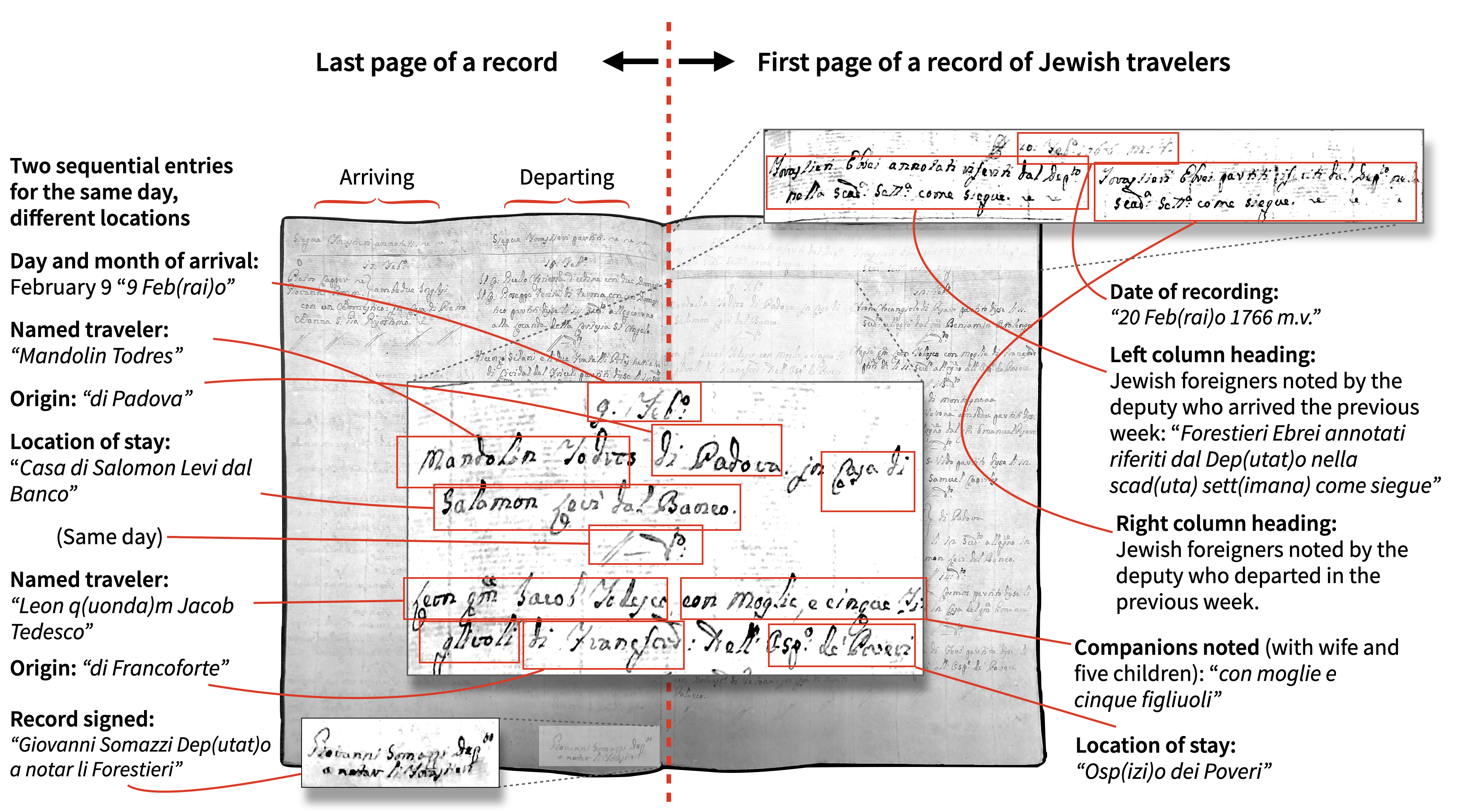
Figure 1. Page spread for February 20, 1766 mv (ASV IS 758-81) diagram of information organization/structure. Click/tap the image to view it full screen.
- The basic organizing principle is temporal and by week.
- The title date is placed in the center of the first page of the record, most frequently in the order day-month-year. Subsequent pages of the same record do not have this date in the top center.
- The arrivals and departures of the foreign visitors are recorded for the preceding week (‘settimana scaduta’).
- Each sheet is divided into two columns: The left column lists the records of presences/arrivals (‘Forestieri annotati riferiti da cameranti nella scaduta settimana come siegue’: ‘Foreigners noted by hoteliers in the past week as follows’) in order by day.
- The right column lists the records of departures (‘Forestieri partiti riferiti da cameranti nella scaduta settimana come siegue’: ‘Foreigners departed recorded by hoteliers in the past week as follows’).
- Within each column, entries are grouped by the day (of arrival or departure) and place of stay (‘in casa di [x] : ‘in the house of [x],’ ‘alla locanda [x]’: ‘in the Inn [x]’, followed by the name of the parish to indicate in which part of Venice the house or inn is located.
- The foreign visitors are listed by name and place of origin. Titles are recorded for some travelers (aristocracy, clergy, physicians, military).
- For some foreign visitors travel companions are noted. These travelers include family members (e.g. ‘moglie’ or ‘figlio/a’ or ‘figliolo/a,’ with number spelled out if relevant) and servants (with number of them spelled out (e.g. ‘due domestici: ‘two domestic servants’, ‘quattro camerieri’: ‘four attendants’ ).
- The records for Jewish travelers follow the same structure but are recorded separately and are reported by a dedicated deputy, ‘deputato,’ not by the hoteliers, and with no additional location information beyond the name of the host ((‘in casa di [x] : ‘in the house of [x]’).
2.3 Visual elements in the documents
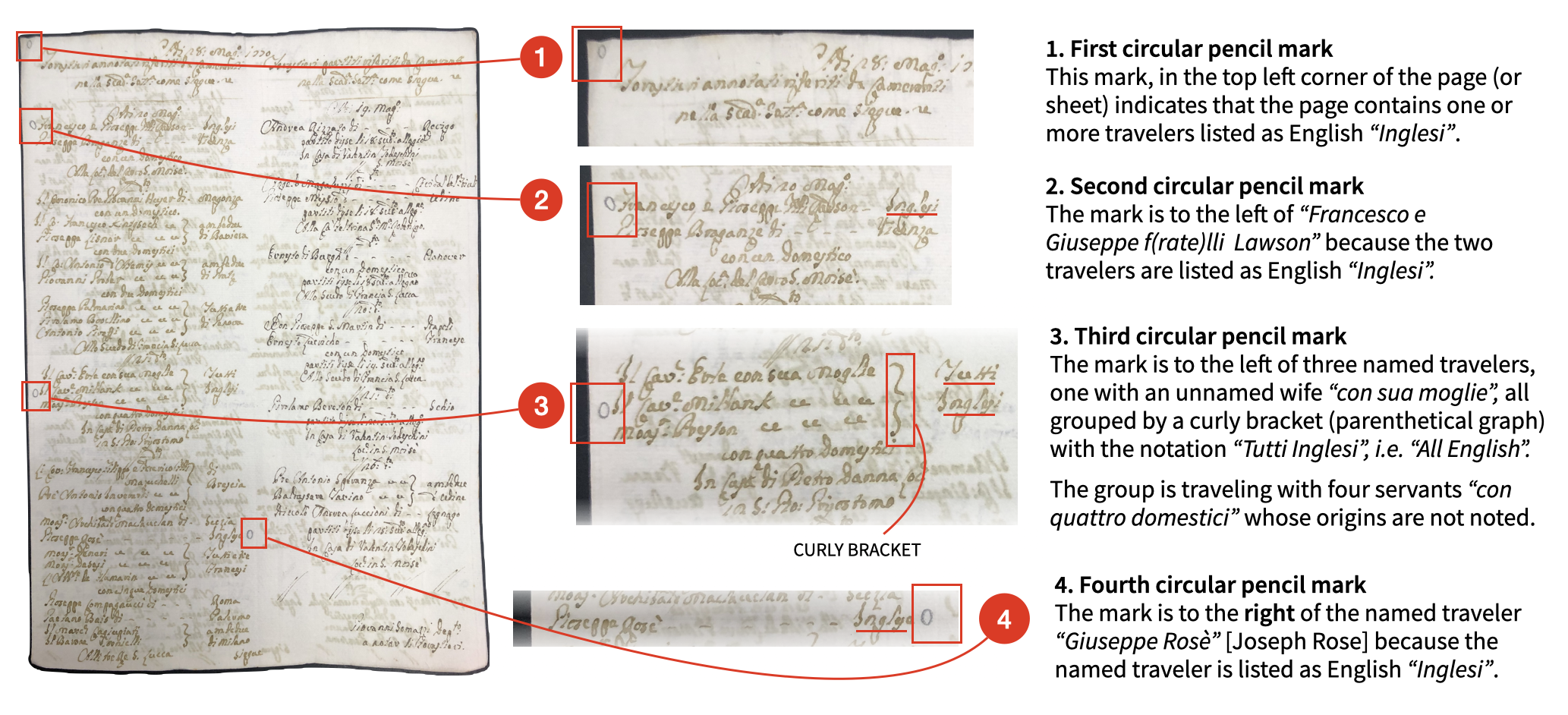
Figure 2. Archivist’s marks in the first page of the May 28, 1770 record (ASV IS 758-81). Click/tap the image to view it full screen.
- At the top left corner of each sheet that contains one or more British names there is a circular pencil mark. The same circular pencil mark is found next to the particular line, or lines, containing records of British travelers. Therefore these circles in pencil appear as two or more per document, except when the line containing the British traveler(s) is in the first entry, close to the top of the sheet, when there may be only one mark.
The presence of these marks was observed by the PI when working with the documents in person in the archives; cross-reference with the PI’s study of Brinsley Ford Archives in London led to the conclusions that these circular pencil marks were added in the late 1960s when Ford commissioned the archivists in Venice to produce a list of all the British visitors in the records and their time of visit (see letter of November 9, 1965 from Zago Ferruccio to Sir Binsley Ford and subsequent correspondence).2
- Column titles are separated from the records below by the drawing of a continuous line in the same ink as the text.
- Curly brackets group together foreign visitors who share the same origin (ranging from a country beyond Italy–expressed adjectivally or by country name–to another Italian state or a town other than Venice within the Venetian state).
- Signature: many of the pages are signed by Giovanni Somazzi, who seems to be the agent in this post from 1765 till at least 1790, and signs himself as ‘Giovanni Somazzi, deputato a notar li forestieri’: ’Giovanni Somazzi deputy to the recording of foreigners.’3
- A curly fret motif, in the same ink as the text, is used to fill empty space at the end of the text within a line.
- Double forward slashes, in the same ink as the text, occupy empty spaces on the page to ensure no more text is added after the official recording.
- Dashes, sometimes more similar to fret, fill the empty space within a line between the end of names and the indication of places of origin.
- ‘Siegue’: ‘follows’ is used in the columns title and also at the end of a sheet and the beginning of the next when the records for a single week occupy more than one sheet.
- MV: this indication follows the dates for the months of January and February to indicate that dates are recorded in the Venetian calendar convention for which the first of the year is March 1st (and therefore what is recorded in these sheets, for example, as January or February 1766 corresponds to January or February 1767 out of Venice).
- Many abbreviations are used that are common in 18th-century handwritten Italian texts: for example contractions (such as the case of Gio as an abbreviation for Giovanni) and superimpositions (such as the case of Franco for Francesco)
3. Questions to be asked across multiple documents
- Pencil marks: find them and check that the note is always ‘Inglesi’. (Are any Irish or Scottish? The question here is about perceptions of nationalities.)
- Count of the British travelers:
- How many are traveling solo versus in groups?
- How large are the groups?
- How many travel with servants and/or family members?
- How many are titled?
- How many are women?
- Where did they stay?
- Did they stay in the same place at the same time as other nationalities?
- Which are reported both arriving and departing?
- Are there any British (Inglesi) among the Jewish travelers?
- Count unique travelers
- Which places of stay and places of origin are mentioned for the travelers?
- Organize in categories (places of origin, places of stay, dates)
- Count in groups and types of groups for travelers and where they stayed
- Identify any patterns in the above
- Compare British and other nationalities
- Count Jewish records, family/groups/servants/places of origins/places of stay
- Identify patterns to look for beyond these sheets
- Find British travelers from these sheets in GTE and beyond (interesting for machine matching transcription to actual British name)
- When is “con” used? “Con [numeral spelled out] “uno,” “due,” ‘tre,” “quattro,” “cinque”
4. Measure of Time Spent on Analysis
Direct evaluation of even one document from this selection can take several hours. Several factors affect this measure of time: the scholar’s familiarity with the archive’s holdings, with the specific set of documents, with previous scholarship and with knowledge transmitted by curators and archivists, all play significant roles in determining the time required for analysis.
The analysis is recursive, but also accretive. As one returns to sources, additional details come into focus. Determining the questions that one might ask of a source (section 3) is a process that evolves over time spent with many documents, learning which questions can be answered and which cannot. Naming categories is a process of identifying emerging patterns, constructing arguments, and arriving at interpretations.
Information retrieval tasks that require reading through the documents and counting, page after page are significantly time consuming. It is essential that these counts and the gathering of specific values be accurate. Scholars doing this work will triple-check the results to be certain of the results. These results become the basis of hypotheses or even of research claims. Any error can upend a research project.
The full lifespan of the document analysis must also consider how the data is gathered, encoded, and annotated with proper citations for authorship. This effort not only provides a solid ground for further work, it can also make the data readily available to further computational analysis and combination with future research projects. Finding a proper means to store and retrieve this data with all of its rich context will be essential to accelerating research practices in the future.
-
DA MOSTO, Archivio di Stato di Venezia, vol. I, Archivi dell’amministrazione centrale della Repubblica Veneta e archivi notarili (1937), p. 61; Gilles Betrand, ‘L’administration vénitienne et l’évolution des techniques d’enregistrement des étrangers dans le contexte de la Révolution française (1789-1797)’ in Diasporas, 29, 2017; For research using these archival material for the 1790s see Valentina Dal Cin, ‘Una nuova Coblenza. Venezia e gli emigrati francesi al tramonto della Repubblica’ in Ateneo Veneto 18:1, 45-69 (2019); ↩
-
in A World Made by Travel: https://aworldmadebytravel.supdigital.org/archive-to-explorer/#paragraph-4], and see Ferruccio’s letter in Ref. No. PMC34/69 file 1 of 4 Ref. No. PMC34/69 file 1 of 4, Ferruccio to Ford, dated Nov. 9, 1965, Paul Mellon Centre Institutional Archive, Paul Mellon Centre, London ↩
-
See Bertrand https://journals.openedition.org/diasporas/778#bodyftn10, ↩